
Criminal Cases in Multnomah County Courts
The Multnomah County Circuit Court, Oregon's Fourth Judicial District, hears state felony and misdemeanor prosecutions. The Central Courthouse is the main records site. The Justice Center hosts proceedings tied to people in custody, and East County Courthouse handles assigned calendars, but records still run through Oregon Judicial Department systems. Portland Municipal Court handles city-code, parking, and some civil-infraction matters. It is not the file keeper for state crimes.
A police report number is not an OJD case number, and an arrest does not guarantee that prosecutors filed a court case. Search the court file for the charge actually filed and the final result. Use the police agency for its report and MCSO for booking data.
Multnomah Court Files at First Avenue
The official Multnomah County criminal case file is maintained by Circuit Court Records at 1200 SW First Avenue, Room 3315, Portland, OR 97204. Walk-in service is available Monday through Friday, 8 a.m. to 4 p.m. Records staff answer 971-274-0570 during 8:30-10:30 a.m. and 1:30-4 p.m.; email requests go to MUL.Records@ojd.state.or.us. Questions about proceedings may go to Mul.Criminal@ojd.state.or.us.
The Multnomah records-order page supports online requests, email, phone, mail, and counter service. A free courthouse terminal supplies most nonconfidential case information when the web view is too thin.
The official court page illustrates Multnomah County record ordering.
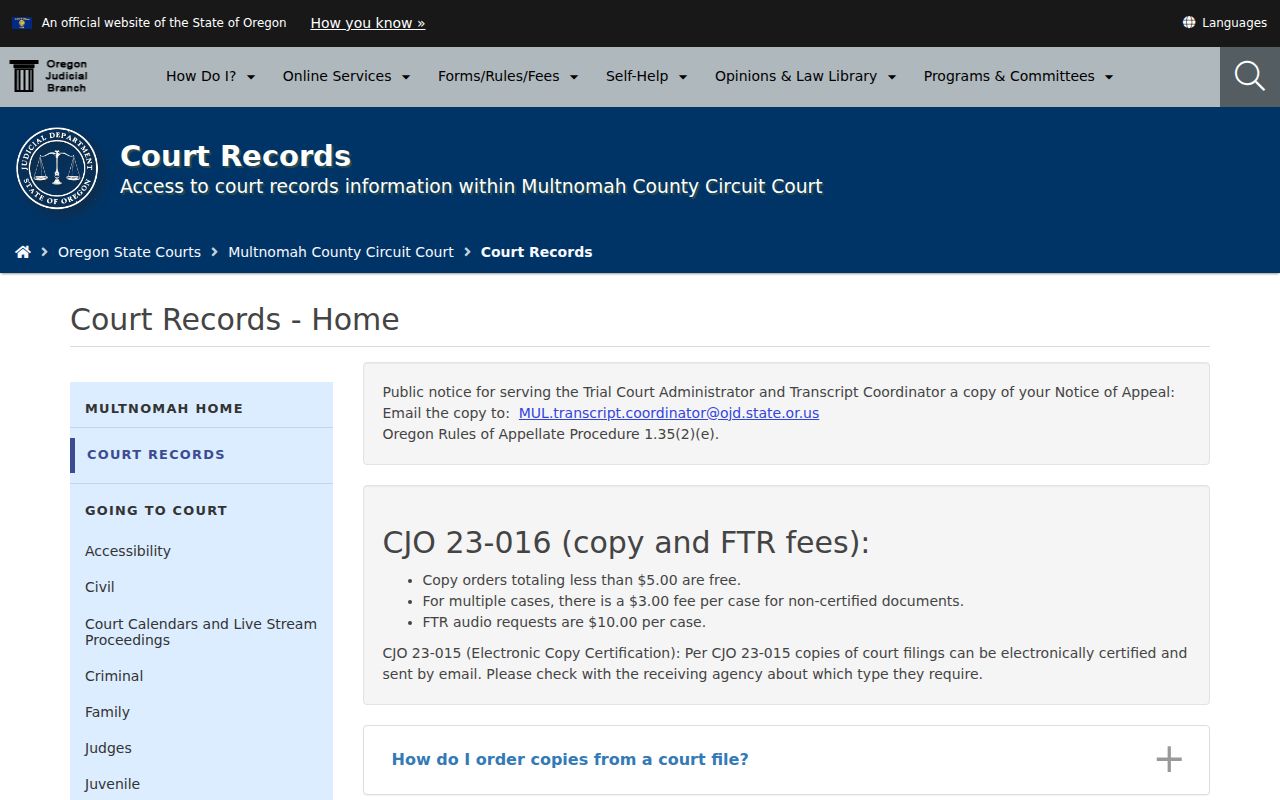
That source connects a search result to copies, certification, audio, and staff help.
How to Search Case Records
Start with the free OJD Records and Calendar Search. It needs no account and gives limited circuit-court information plus upcoming appearances. The result is not the official register, and protected matters do not appear.
- Use a case number when possible; otherwise enter the party or defendant name.
- Open advanced options and narrow the court to Multnomah and the relevant criminal record type.
- Confirm filing date, charge, status, and case number before accepting a same-name result.
- Check the calendar again on the hearing date because settings can change.
- Use OJCIN, a courthouse terminal, or the clerk when the free summary is not enough.
| Field Label | Type | Required | Notes |
|---|---|---|---|
| Smart Search | Text | Yes | Case number or party name |
| Court Location | Select | No | Choose Multnomah |
| Record Type | Select | No | Criminal or violation |
| Attorney / Judicial Officer | Search | No | Calendar tool |
| Date From / To | Date | No | Calendar range |
Free Search or Multnomah OJCIN
The free portal works for a case number, basic status, and the next hearing. OJCIN OnLine is the registered, paid route to fuller registers of actions and judgments. Its OECI system covers all Oregon circuit courts, with public filed documents available in some cases. Data update near real time, but the filing court remains authoritative.
Use a courthouse terminal for a one-time fuller search. Use OJCIN when repeat docket work justifies an account. Order from Multnomah County when a filed pleading, judgment, certification, or audio is needed.
The official OJCIN explanation shows why it differs from free search.
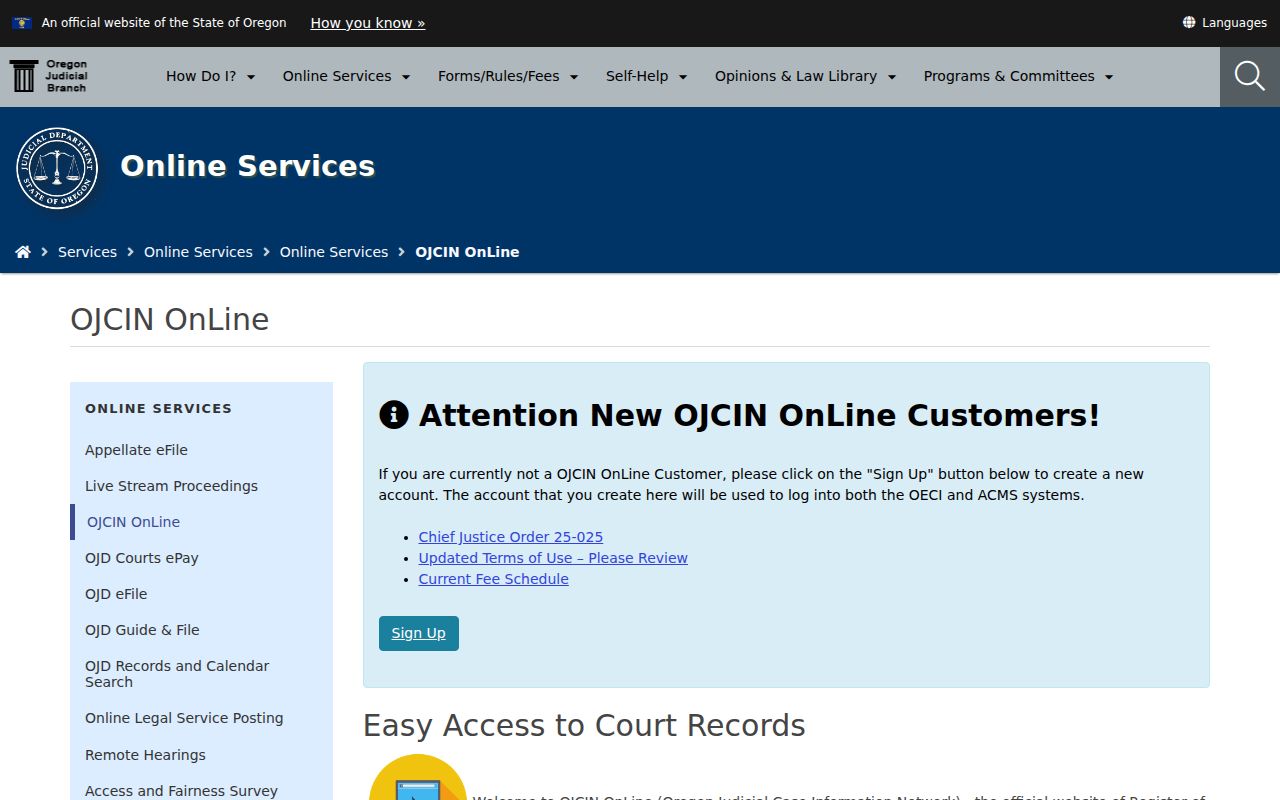
It also routes subscribers to current support and fee details.
What the Case File Shows
A Multnomah County docket is a chronology, not a one-line verdict. Read each charge beside its disposition. An allegation may be amended or dismissed, and a closed status does not itself mean conviction.
| Case Number & Court | Unique OJD file and location |
|---|---|
| Charging Document | Complaint or indictment allegations |
| Docket Entries | Hearings, motions, pleas, trial, and filings |
| Hearing Dates | Scheduled events, subject to change |
| Disposition & Judgment | Result for each charge |
| Sentence & Conditions | Court-ordered terms after judgment |
Reading Multnomah Case Outcomes
A dismissal ends a charge without conviction. An acquittal resolves guilt in the defendant's favor. A guilty or no-contest plea can lead to judgment and sentence. Diversion and treatment-court entries require later review because entry alone is not the final result. Multnomah programs such as STOP, DISP, and Veterans Treatment Court may add review hearings.
- Arraignment
- The first formal appearance on filed charges.
- Disposition
- The way a charge ends, such as dismissal, plea, or verdict.
- Register of Actions
- The dated list of filings and court events.
- Judgment
- The court's formal decision after adjudication.
Do not infer program participation or conviction from one line. Read the later events and final judgment.
Stages of a Criminal Case
Multnomah County criminal cases move through a known sequence, though dismissal, diversion, or a plea may shorten it. The District Attorney decides whether to file after reviewing a police submission. The court then assigns a case number and records counsel, motions, and hearings. Booking charges may differ from filed counts and the judgment.
Charges Filed → Arraignment → Pretrial → Plea or Trial → Disposition → Sentencing
Appeals create a separate appellate trail in OJCIN's ACMS component. The Multnomah County arrest history explains why agency and court records may not align at once.
Order Multnomah Court Copies
The clerk's form asks for contact details, case number and name, a defendant's birth date, exact document or hearing, delivery method, and certification choice. Submit online, email, mail, phone, or at Room 3315. The form allows five judicial days for acknowledgment or possible completion, not a guaranteed delivery date.
Posted guidance makes orders under $5 free, charges $3 per case for noncertified documents spanning multiple cases, and lists FTR audio at $10 per case. Archived records may need staff retrieval. Ask whether a plain or certified copy is required.
The free statewide interface is the first view of Multnomah County criminal cases.
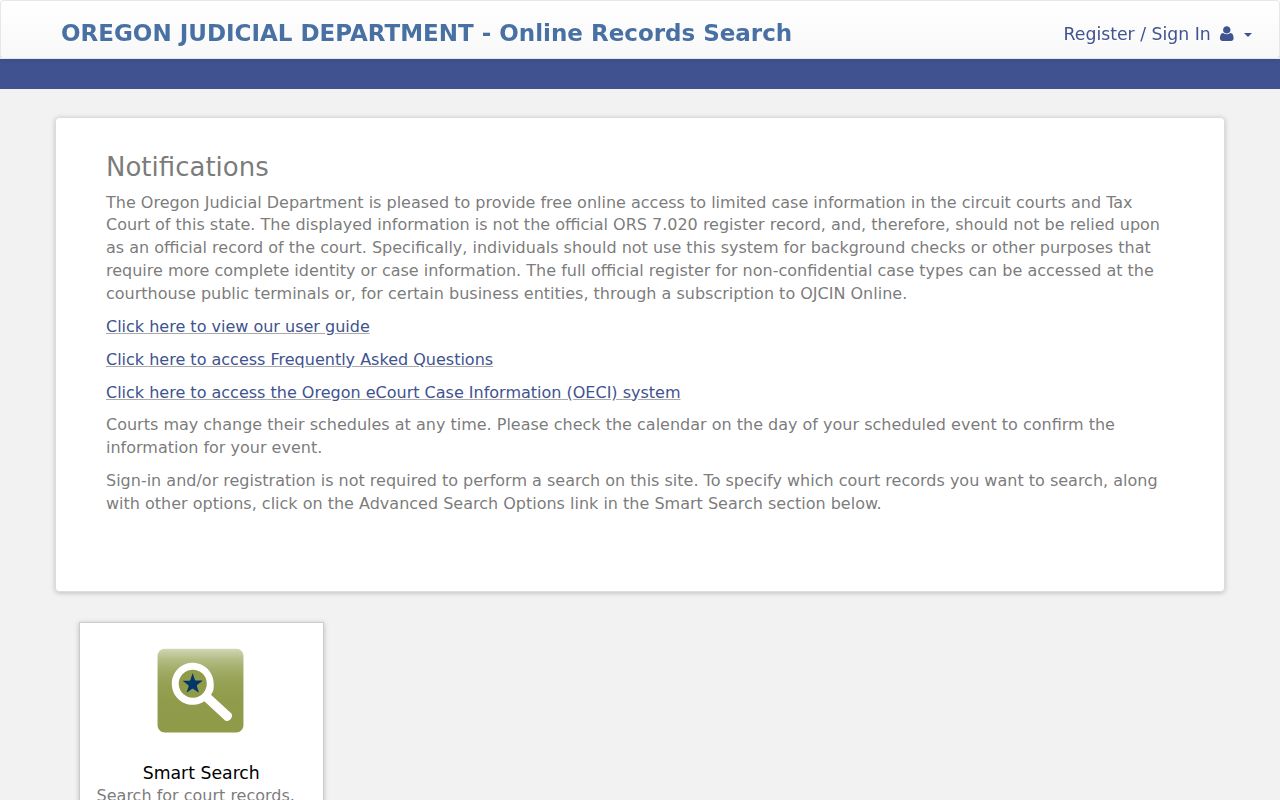
The clerk remains the source for official filings and certification.
Access & Restrictions
Oregon court records are generally open, but access is not absolute. Juvenile, adoption, mental-health, sealed, set-aside, and protected-person information can be withheld or omitted online. Personal identifiers may be redacted. Older paper files, audio, and restricted records may require a focused request and legal authority.
ORS 7.020 makes the register the official record. If a Multnomah County case is absent, check spelling, location, filing delay, municipal jurisdiction, another county, or federal court. Then ask staff whether a public file exists and what process applies. Online redaction may differ from the filed document. Give the clerk an exact case number, document date, and title so staff can determine whether it is public, restricted, archived, or merely absent from the free interface.
Multnomah or Federal Docket
Federal prosecutions do not appear in OJD. They belong to the U.S. District Court for the District of Oregon and are searched through PACER. The Mark O. Hatfield U.S. Courthouse clerk is the fallback for archived or certified federal material. Sealed filings and grand-jury records remain unavailable.
PACER requires registration and follows its own current pricing rules. Search by party or case number, then confirm that the District of Oregon matter is the intended file. The U.S. Attorney prosecutes federal charges, but that office is not the docket custodian. Likewise, the U.S. Marshals Service may handle custody and court security without replacing the clerk's record.
A blank OJD result may therefore call for a PACER check. Keep the systems distinct: OJD covers Oregon cases, PACER covers federal dockets, MCSO covers county custody, and OSP holds repository history. For a nationwide copy of one's own fingerprint-linked identity history, use the FBI Identity History Summary process, not either court search. Each channel answers a different question, and none should be read as a substitute for the final judgment.